
• Federated Learning & Secure MPC
Your Legal team will block the central aggregator. Your compliance team will flag the gradient exports. Stoffel removes the aggregator from trust boundaries entirely — nobody sees each other's contribution, including us. No exposure window, nothing to audit, and nothing to subpoena.
Built for teams stuck between innovation and compliance
ML Teams at Multi-Party Organizations
Train on signal you can't centralize
Get model lift without exposing raw updates
Run consortium PoCs your Legal team can actually sign off on
Privacy-Focused Product Teams
Meet privacy requirements structurally, not procedurally
Build features that require distributed training
Run product analytics without a central data store that can be breached or subpoenaed
Infrastructure Teams Managing Consortium Data
Remove the central aggregator from the trust boundary
Run federated workflows without "trusted third party" assumptions
No new data-sharing agreements. No new vendor access to redline
Privacy guarantees you can actually explain in a review meeting
Stop arguing about who to trust with aggregation. The system architecture prevents anyone from seeing individual updates — including us.
No One Sees Individual Updates
Not even the aggregator can read another participant's gradients
Parties jointly compute the aggregate using MPC
Individual updates remain cryptographically hidden throughout
Only the combined model is revealed to participants
Control What Leaves Each Round
Policy enforcement at the protocol level, not the promise level
Only global model and approved metrics are revealed
No raw updates, no plaintext gradients, no CSV exports
Define output policy once; the system enforces it
Keep Your Existing Pipeline
Drop-in integration with Flower, not a framework rewrite
Use your current Python and Flower code
Configure clipping and differential privacy as usual
No data lake merges, no new agents on analyst machines
The full stack. Private by architecture
FedAvg Module in Stoffel Lang
Drop-in replacement for your Flower aggregation strategy with MPC privacy guarantees built in.
Orchestration Layer
Handles round management, timeouts, and partial participation so your training runs don't break when someone drops.
Python/Flower Adapter SDK
Call the Stoffel aggregator exactly like you'd call a standard FedAvg server—same interface, private backend.
Local Development Tools
Test your aggregation logic locally before deploying to multi-party environments.
Output Policy Configuration
Specify which metrics and artifacts can leave each round — everything else stays encrypted. Auditable output policy, definable once, enforced by the system
Documentation & Integration Support
Step-by-step migration guides for existing Flower deployments — and a compliance architecture overview for teams evaluating the security model.
For Engineering Teams
Ship like a normal developer
Privacy happens in the background
We built this for teams who want structural guarantees, not policy promises. You shouldn't have to become a cryptographer to stop accumulating liability.
Familiar Code Patterns
Same Flower interface you're already using—just point to our aggregator endpoint.
Clear Error Messages
No cryptic protocol failures—actual debugging information when something goes wrong.
Honest About Tradeoffs
MPC adds computation time. We're upfront about performance characteristics so you can decide if the tradeoff works.
Three steps. No data movement
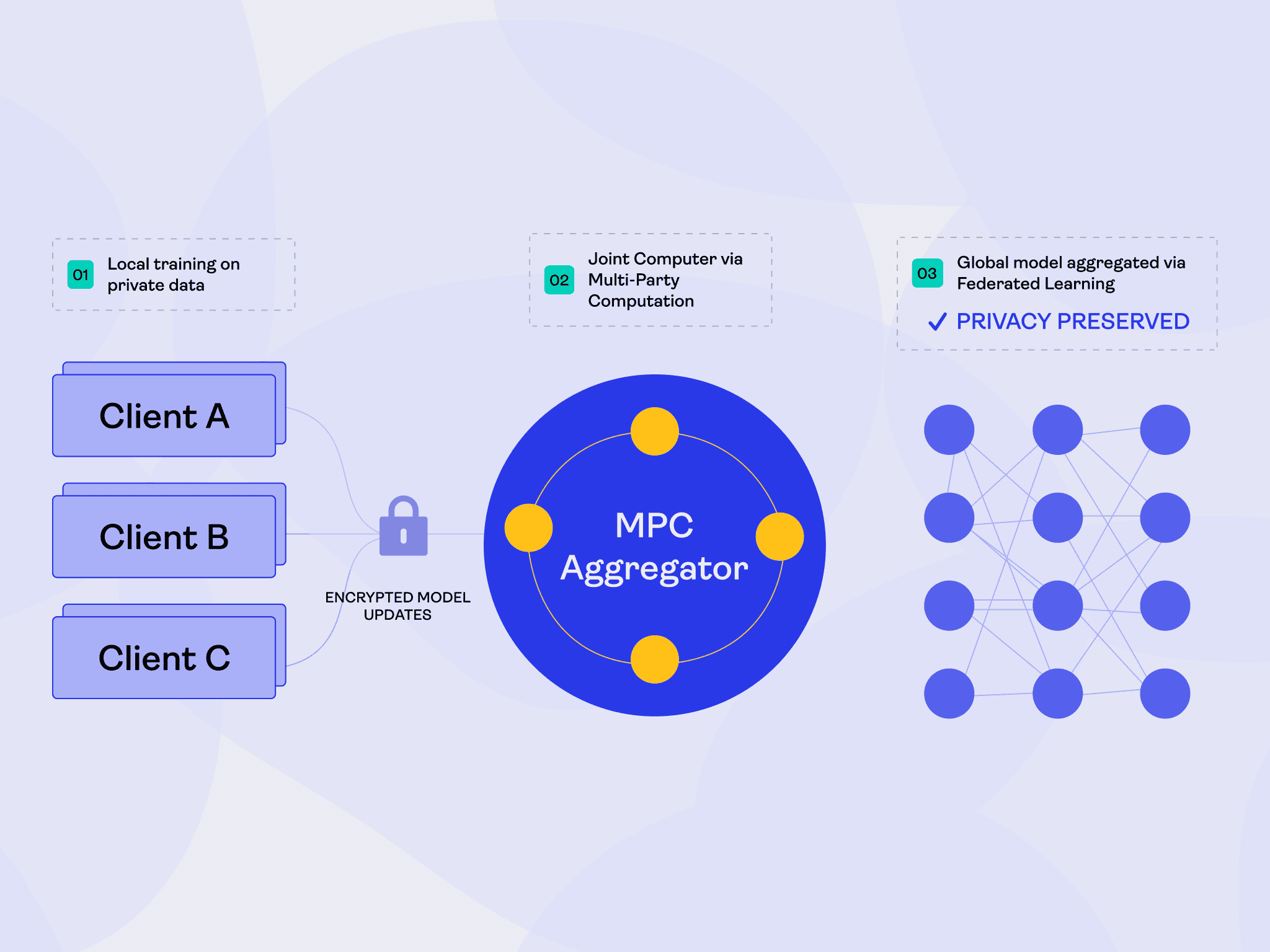
Local Training
Each party trains on their local data as usual. Nothing leaves their environment at this stage.
Private Aggregation
The computation happens jointly. No party can read another's contribution — during and after aggregation. Architectural guarantee, not a policy promise.
Distribution
Everyone receives the new global model. That's all they learn—the aggregate result, no individual contributions.
FAQ
Have more questions? Contact our team with any questions you may have.
Does any raw data move between parties?
No. Each party trains locally. Only the aggregate model is computed and shared. Individual updates never leave in plaintext.
How do you handle stragglers or parties dropping out?
Built-in support for timeouts and partial participation. If someone doesn't respond, the round continues with available parties.
Can I use differential privacy and gradient clipping?out Stoffel
Yes. Hook points exist in the protocol for both. Configure them like you would in standard Flower.
What's the performance impact compared to plaintext aggregation?
MPC adds computation overhead. Exact impact depends on number of parties and network conditions. We recommend piloting with your actual setup to evaluate the tradeoff.