What is Multi-Party Computation?
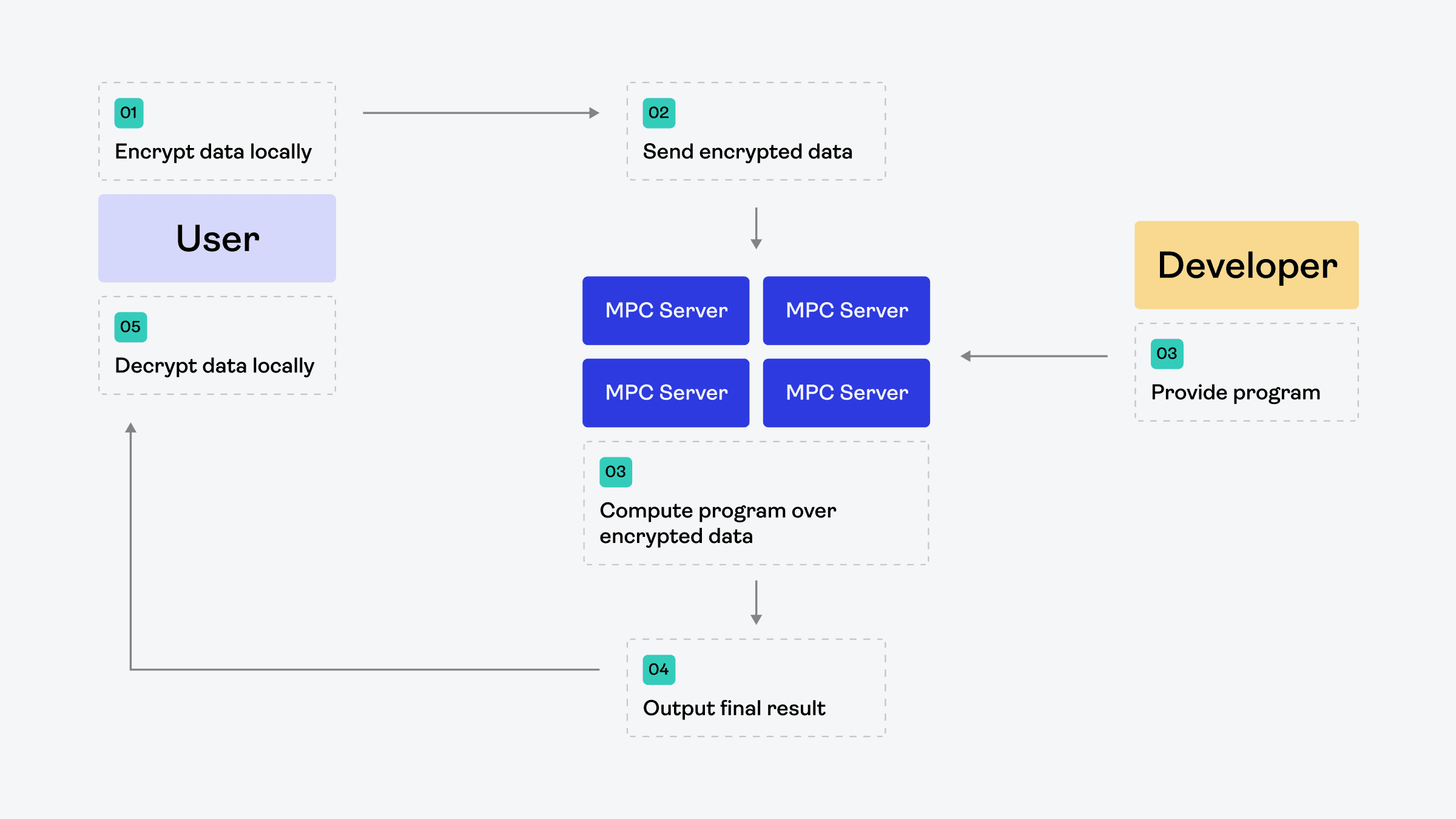
Imagine three hospitals want to research a rare disease together. Each has patient data that could help, but they can't share it due to privacy laws. Traditional solutions force an impossible choice:
Share data: Privacy violations, regulatory issues
Keep data separate: Limited insights, slower progress
But with MPC the hospitals could compute together, and keep their data private.
How Does MPC Work?
MPC works by splitting sensitive data into "shares" - meaningless pieces that only reveal information when combined.
Original secret: 1000
Split into shares:
- Party A gets: 847392847 (random)
- Party B gets: 392847364 (random)
- Party C gets: 847392949 (random)
Individually: Shares reveal nothing
Combined: 847392847 + 392847364 + 847392949 = 1000
Use MPC when:
You need to process private data and control when (or if) it becomes public.
Use ZK when:
You need to prove something happened without exposing the details.
Use FHE when:
You need to run computations on data without ever exposing it.
Use TEE when:
You need hardware-level isolation for processing sensitive code and data.
Combine them for even more power
MPC
+
ZK
Prove your computation was correct without revealing the data.
MPC
+
FHE
Process sensitive data across multiple services while keeping it encrypted.
MPC
+
TEE
Speed up secure multi-party computation using trusted hardware.